Castle Atlas / No. 21
Edo Castle
江戸城
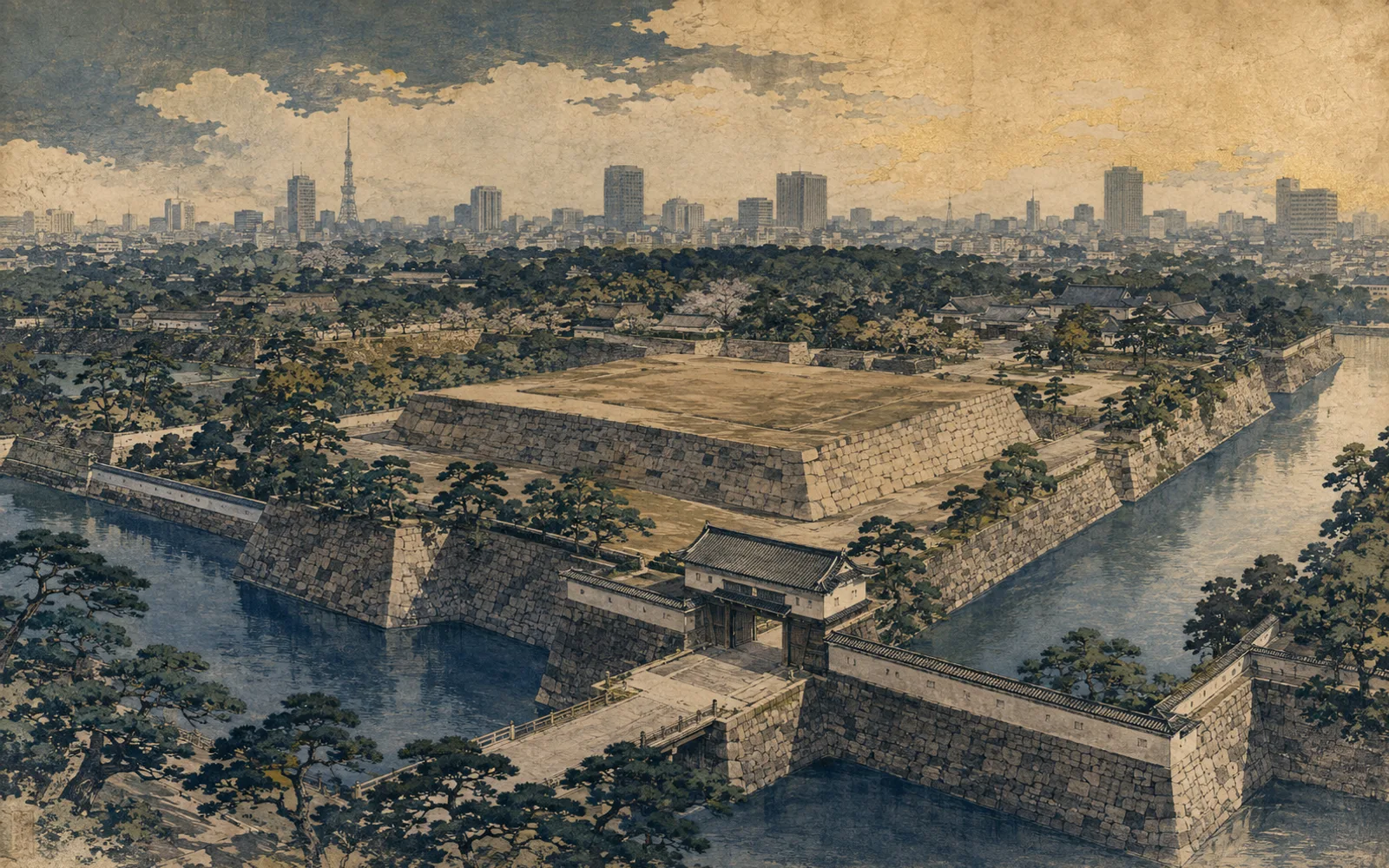
Edo Castle was the Tokugawa shogunate’s political center and later became the Imperial Palace landscape, making it one of the clearest cases where a castle survives as urban ground, gates, moats and power geography.
History
What historically stood here
The Japan Castle Foundation records 江戸城 as a 平城 site in 千代田区, with the founding label 長禄元年(1457)、慶長11年(1606)、元和8年(1622)、寛永14年(1637). The listed builder or associated clan is 太田道灌、徳川家康、徳川秀忠、徳川家光; principal lords are 太田氏、小田原北条氏、徳川氏.
The site’s history spans Edo period, Meiji transition, modern imperial precinct.
Today
What you are actually seeing today
You are not seeing a keep. You are reading moats, gates, stone walls, the keep base, gardened precincts and restricted palace geography embedded inside central Tokyo.
- Current condition
- Original buildings, no keep
- Terrain
- Hirajiro: flatland castle
- Condition note
- Original buildings: 櫓、門. Classified 2026-09-24 from the structured fields at https://cmeg.jp/w/castles/2140.
Architecture And Defense
How to read the place
- moats
- stone walls
- keep base
- urban palace landscape
Cultural-property notes in the Foundation row: 国指定特別史跡, 国指定史跡, 重要文化財6件, 都指定重要文化財多数.
Visit
Present-day visitor information
Imperial Palace East Gardens and outer-garden access vary by area; check the official palace/garden sources before visiting.
- Address or access location
- 東京都千代田区千代田
- Coordinates
- 35.688325, 139.754366
- Nearest useful station
- Tokyo Station, Otemachi Station, or Nijubashimae Station depending on entry point
- Estimated visit duration
- 1.5-3 hours
- Opening hours
- Check the official visitor source.
- Admission
- Check the official visitor source.
Seasonal planning note
- Garden access and event closures should be checked before routing around the palace grounds.
Nearby
Castles close enough to compare
Shinagawa Daiba
Tokyo / Stonework and earthworks
Kozukue Castle
Kanagawa / Reconstructed gates, turrets or buildings
Kawagoe Castle
Saitama / Original buildings, no keep
Takiyama Castle
Tokyo / Stonework and earthworks
Sources
Source and correction context
Identity, list membership, Foundation list number, municipality, basic classification and cultural-property notes are source-verified. Site-level visitor details require additional review unless this record is publishable. Foundation numbers are official list identifiers, not rankings. Coordinates use the Foundation-linked position-data KML and should be treated as visitor-planning coordinates rather than archaeological survey points.
Sources
- Japan's Top 100 and Continued Top 100 Castle Position Data, Japan Castle Foundation / Nippon Castle. Accessed 2026-09-04. Used for the 200 castle addresses and coordinates exposed through the public map linked from the Japan Castle Foundation castle-search page.
- Japan's Top 100 Castles, Japan Castle Foundation. Accessed 2026-09-04. Used for the official identity, list number, list membership, location municipality, castle type, founding label, builders, principal lords, cultural-property notes, and keep-status notes for the original 100-castle selection.
- 100 Fine Castles of Japan and Continued 100 Fine Castles of Japan, Wikipedia contributors. Accessed 2026-09-04. Used only as a secondary cross-check for common English castle names; Japan Castle Foundation records remain the corpus source of truth.
- Nippon Shiro Meguri castle records: keep structure, remains and rebuilt structures, Nippon Shiro Meguri (cmeg.jp). Accessed 2026-09-24. Structured fields for each of the 200 castles, used to classify what stands at each site today. The linked record for each castle is its coordinate source.