Castle Atlas / No. 59
Himeji Castle
姫路城
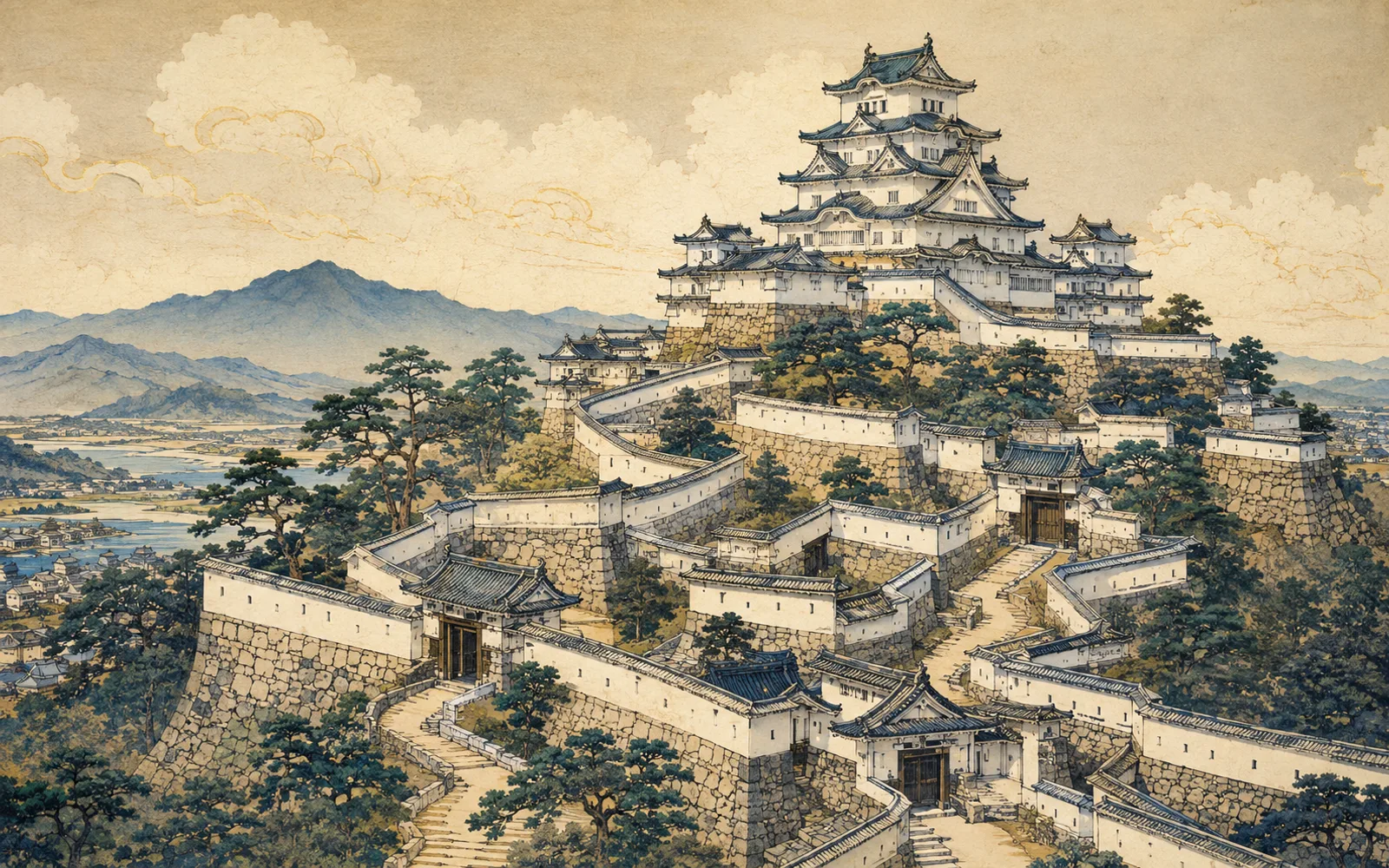
Himeji Castle is the atlas’s strongest surviving-castle anchor: a World Heritage and National Treasure complex whose defensive systems, white plaster and layered wooden buildings survived with unusual completeness.
History
What historically stood here
The Japan Castle Foundation records 姫路城 as a 平山城 site in 姫路市, with the founding label 天正8年(1580)、慶長6年(1601). The listed builder or associated clan is 羽柴(豊臣)秀吉、池田輝政; principal lords are 豊臣氏、池田氏、本多氏、松平氏、榊原氏、酒井氏.
The site’s history spans Sengoku, early Edo, modern preservation.
Today
What you are actually seeing today
You are seeing an original wooden keep complex and many surviving structures. The famous white tower is not a postwar concrete rebuild.
- Current condition
- Original surviving keep
- Terrain
- Hirayamajiro: hill-on-plain castle
- Condition note
- Keep field marks the keep as surviving (現存). Classified 2026-09-24 from the structured fields at https://cmeg.jp/w/castles/5849.
Architecture And Defense
How to read the place
- original National Treasure keep
- World Heritage complex
- white plaster walls
- maze-like defensive approach
Cultural-property notes in the Foundation row: 国指定特別史跡, 国宝8件, 重要文化財74件.
National Treasure context: listed in Foundation cultural-property field.
UNESCO context: World Heritage: Himeji-jo.
Visit
Present-day visitor information
Public visitor site; check Himeji Castle official information before relying on admission, hours or crowd notices.
- Address or access location
- 兵庫県姫路市本町68
- Coordinates
- 34.839426, 134.693985
- Nearest useful station
- Himeji Station
- Estimated visit duration
- 3-5 hours
- Opening hours
- Check the official visitor source.
- Admission
- Check the official visitor source.
Seasonal planning note
- Crowds can be heavy in blossom season and during major holidays.
Nearby
Castles close enough to compare
Akō Castle
Hyogo / Reconstructed gates, turrets or buildings
Akashi Castle
Hyogo / Original buildings, no keep
Takeda Castle
Hyogo / Mountain castle ruins
Kuroi Castle
Hyogo / Mountain castle ruins
Sources
Source and correction context
Identity, list membership, Foundation list number, municipality, basic classification and cultural-property notes are source-verified. Site-level visitor details require additional review unless this record is publishable. Foundation numbers are official list identifiers, not rankings. Coordinates use the Foundation-linked position-data KML and should be treated as visitor-planning coordinates rather than archaeological survey points.
Sources
- Japan's Top 100 and Continued Top 100 Castle Position Data, Japan Castle Foundation / Nippon Castle. Accessed 2026-09-04. Used for the 200 castle addresses and coordinates exposed through the public map linked from the Japan Castle Foundation castle-search page.
- Japan's Top 100 Castles, Japan Castle Foundation. Accessed 2026-09-04. Used for the official identity, list number, list membership, location municipality, castle type, founding label, builders, principal lords, cultural-property notes, and keep-status notes for the original 100-castle selection.
- Discover Japan's Twelve Original Castles, Japan National Tourism Organization. Accessed 2026-09-04. Used as visitor-facing context for the surviving original-keep distinction, while individual list identity remains sourced to the Japan Castle Foundation.
- Himeji-jo, UNESCO World Heritage Centre. Accessed 2026-09-04. Used for Himeji Castle's World Heritage context.
- 100 Fine Castles of Japan and Continued 100 Fine Castles of Japan, Wikipedia contributors. Accessed 2026-09-04. Used only as a secondary cross-check for common English castle names; Japan Castle Foundation records remain the corpus source of truth.
- Nippon Shiro Meguri castle records: keep structure, remains and rebuilt structures, Nippon Shiro Meguri (cmeg.jp). Accessed 2026-09-24. Structured fields for each of the 200 castles, used to classify what stands at each site today. The linked record for each castle is its coordinate source.