Castle Atlas / No. 43
Inuyama Castle
犬山城
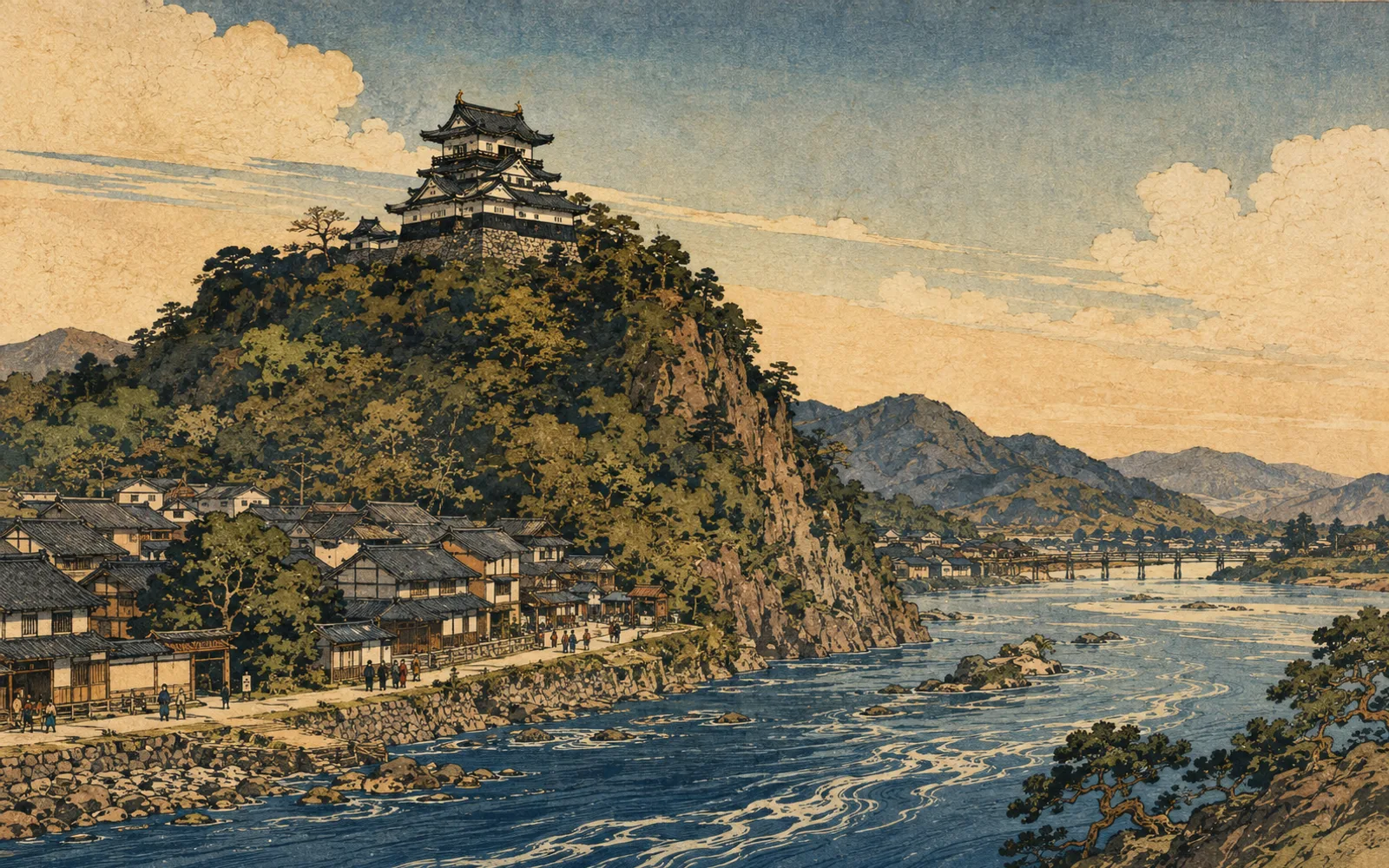
Inuyama Castle is a compact original keep above the Kiso River, showing how a relatively small tower can still dominate terrain, crossing routes and castle-town memory.
History
What historically stood here
The Japan Castle Foundation records 犬山城 as a 平山城 site in 犬山市, with the founding label 天文6年(1537). The listed builder or associated clan is 織田信康; principal lords are 織田氏、小笠原氏、成瀬氏.
The site’s history spans Muromachi/Sengoku, Edo period, modern preservation.
Today
What you are actually seeing today
You are seeing an original wooden National Treasure keep on a hill site, with river views and a compact surrounding town rather than a vast reconstructed complex.
- Current condition
- Original surviving keep
- Terrain
- Hirayamajiro: hill-on-plain castle
- Condition note
- Keep field marks the keep as surviving (現存). Classified 2026-09-24 from the structured fields at https://cmeg.jp/w/castles/4391.
Architecture And Defense
How to read the place
- original National Treasure keep
- river bluff position
- castle-town approach
Cultural-property notes in the Foundation row: 国宝1件(天守), 国指定史跡.
National Treasure context: listed in Foundation cultural-property field.
Visit
Present-day visitor information
Public visitor site; check Inuyama Castle for current entry and crowd information.
- Address or access location
- 愛知県犬山市犬山北古券65-2
- Coordinates
- 35.388329, 136.939248
- Nearest useful station
- Inuyamayuen Station or Inuyama Station
- Estimated visit duration
- 1.5-2.5 hours
- Opening hours
- Check the official visitor source.
- Admission
- Check the official visitor source.
Seasonal planning note
- River views, blossom and autumn foliage can shift the visit from architecture-first to landscape-first.
Nearby
Castles close enough to compare
Komakiyama Castle
Aichi / Stonework and earthworks
Gifu Castle
Gifu / Rebuilt or replica keep
Mino Kaneyama Castle
Gifu / Mountain castle ruins
Nagoya Castle
Aichi / Rebuilt or replica keep
Sources
Source and correction context
Identity, list membership, Foundation list number, municipality, basic classification and cultural-property notes are source-verified. Site-level visitor details require additional review unless this record is publishable. Foundation numbers are official list identifiers, not rankings. Coordinates use the Foundation-linked position-data KML and should be treated as visitor-planning coordinates rather than archaeological survey points.
Sources
- Japan's Top 100 and Continued Top 100 Castle Position Data, Japan Castle Foundation / Nippon Castle. Accessed 2026-09-04. Used for the 200 castle addresses and coordinates exposed through the public map linked from the Japan Castle Foundation castle-search page.
- Japan's Top 100 Castles, Japan Castle Foundation. Accessed 2026-09-04. Used for the official identity, list number, list membership, location municipality, castle type, founding label, builders, principal lords, cultural-property notes, and keep-status notes for the original 100-castle selection.
- Discover Japan's Twelve Original Castles, Japan National Tourism Organization. Accessed 2026-09-04. Used as visitor-facing context for the surviving original-keep distinction, while individual list identity remains sourced to the Japan Castle Foundation.
- 100 Fine Castles of Japan and Continued 100 Fine Castles of Japan, Wikipedia contributors. Accessed 2026-09-04. Used only as a secondary cross-check for common English castle names; Japan Castle Foundation records remain the corpus source of truth.
- Nippon Shiro Meguri castle records: keep structure, remains and rebuilt structures, Nippon Shiro Meguri (cmeg.jp). Accessed 2026-09-24. Structured fields for each of the 200 castles, used to classify what stands at each site today. The linked record for each castle is its coordinate source.