A white washing toilet in a dark teal tiled room lit by a narrow window.Japan Almanac / Features

Everyday Japan / Design & technology

How Japan
rebuilt the toilet.

Read the story

More Japanese households now have a washing toilet seat than a car. The idea came from America, the engineering from Japan, and the rest of the world is still catching up. How it happened, and what the buttons do.

More common than a car

In March 2026, 82.5% of Japanese households with two or more people had a warm-water washing toilet seat. That is more than had a car (76.2%) or a computer (74.7%), and on average there are 117 seats for every 100 of those households. The Cabinet Office tracks them alongside air conditioners and televisions, as ordinary household equipment.

The idea was imported. Japan’s restroom industry dates the washing seat’s arrival to 1964, when an American design, the Wash Air Seat, reached the country. It had problems: the water could come out at the wrong temperature, and the spray did not reliably hit its target. TOTO’s own history describes both complaints.

Japanese makers spent the next two decades fixing them. In 1967 the company now called INAX introduced the Sanitarina 61, a toilet with warm-water washing and drying, and in 1976 it sold the system as a seat that fits an existing toilet. TOTO began work on its own model in 1978, measuring more than 300 volunteers to work out where the spray should go. It launched the WASHLET in June 1980. The brand name stuck, but INAX had been selling washing toilets for years.

Sources for this section ↓

How the toilet changed.

  1. 1983–1999

    A better spray, a smoother bowl

    TOTO added a self-cleaning wand in 1983. The 1993 NEOREST EX combined a tankless toilet with electronic flushing and pulsating or oscillating washing. CEFIONTECT, introduced in 1997, gave the ceramic a smoother glaze. The 1999 Apricot eliminated the hot-water tank. The equipment was becoming smaller and easier to keep clean.

    TOTO product history ↗

  2. 2001–2003

    Tankless toilets and automatic controls

    INAX launched the compact, tankless SATIS in 2001. TOTO’s developments included an automatic energy saver that year, a rimless bowl and TORNADO flush in 2002, then automatic lid opening and flushing in 2003. Space, electricity use and the chore of cleaning under the rim were now part of the design brief.

    TOTO product history ↗ · INAX heritage ↗

  3. 2006

    Panasonic changes the material

    Panasonic’s Arauno arrived in December 2006 with a resin bowl instead of ceramic. It used fine foam made with neutral kitchen detergent, together with the flushing water, to clean the bowl. Panasonic chose to compete on how much cleaning the toilet could do for its owner.

    Panasonic’s Arauno account ↗

  4. 2011–2016

    Cleaning becomes part of the cycle

    TOTO introduced EWATER+ for the wand in 2011 and the bowl in 2012. INAX followed a different materials route with Aqua Ceramic in 2016, developed to make waste and water stains easier to remove. By this point, manufacturers were working on what happened after the wash as well as during it.

    TOTO product history ↗ · INAX heritage ↗

From an upgrade to an everyday fixture

Ownership rose from 59.7% of households in 2005 to 82.5% in 2026, and has stayed around 80% since 2016. Cabinet Office, March of each year, households with two or more people.

59.7%2005

82.5%2026

Japanese washing-seat ownership, 2005 to 2026Ownership among households with two or more people rose from 59.7 percent in 2005 to 82.5 percent in 2026. Full annual values are in the table below.50%60%70%80%90%200520152026

Cabinet Office, March observations. Household ownership of warm-water washing toilet seats. This does not measure how often people use them.

Read the annual figures

200559.7%

200662.7%

200765.3%

200868.3%

200969.1%

201071.6%

201170.9%

201273.5%

201374%

201476%

201577.5%

201681.2%

201779.1%

201880.2%

201980.4%

202080.2%

202180.3%

202280.3%

202381.7%

202482%

202582.5%

202682.5%

Why the American version stalled

Brooklyn inventor Arnold Cohen developed a washing-and-drying seat in the 1960s to help his father. Selling it was the hard part. In a 2007 interview with the Miami New Times, he recalled newspaper ads, trade shows and buyers who did not see the point. In 1964 a Japanese trading company took an interest and adapted the device for Japan.

Cohen’s American Bidet company never came close to Japanese household numbers. It did survive: in 2007 he was still making seats in Florida and selling them online, and he estimated his lifetime sales at a few hundred thousand at most. Kohler introduced its C3 washing seat in 2006 and, in 2011, the Numi, with a bidet, heated seat, foot warmer, automatic lid and built-in music.

The gap is in ordinary homes. In a 2022 YouGov survey, 6% of US adults said they already had a bidet at home. Interest is growing among people who renovate: in Houzz’s 2025 study, 21% of homeowners adding or upgrading a toilet chose a bidet seat. Those renovators are not a sample of all American homes, but they show where interest is growing.

Sources for this section ↓
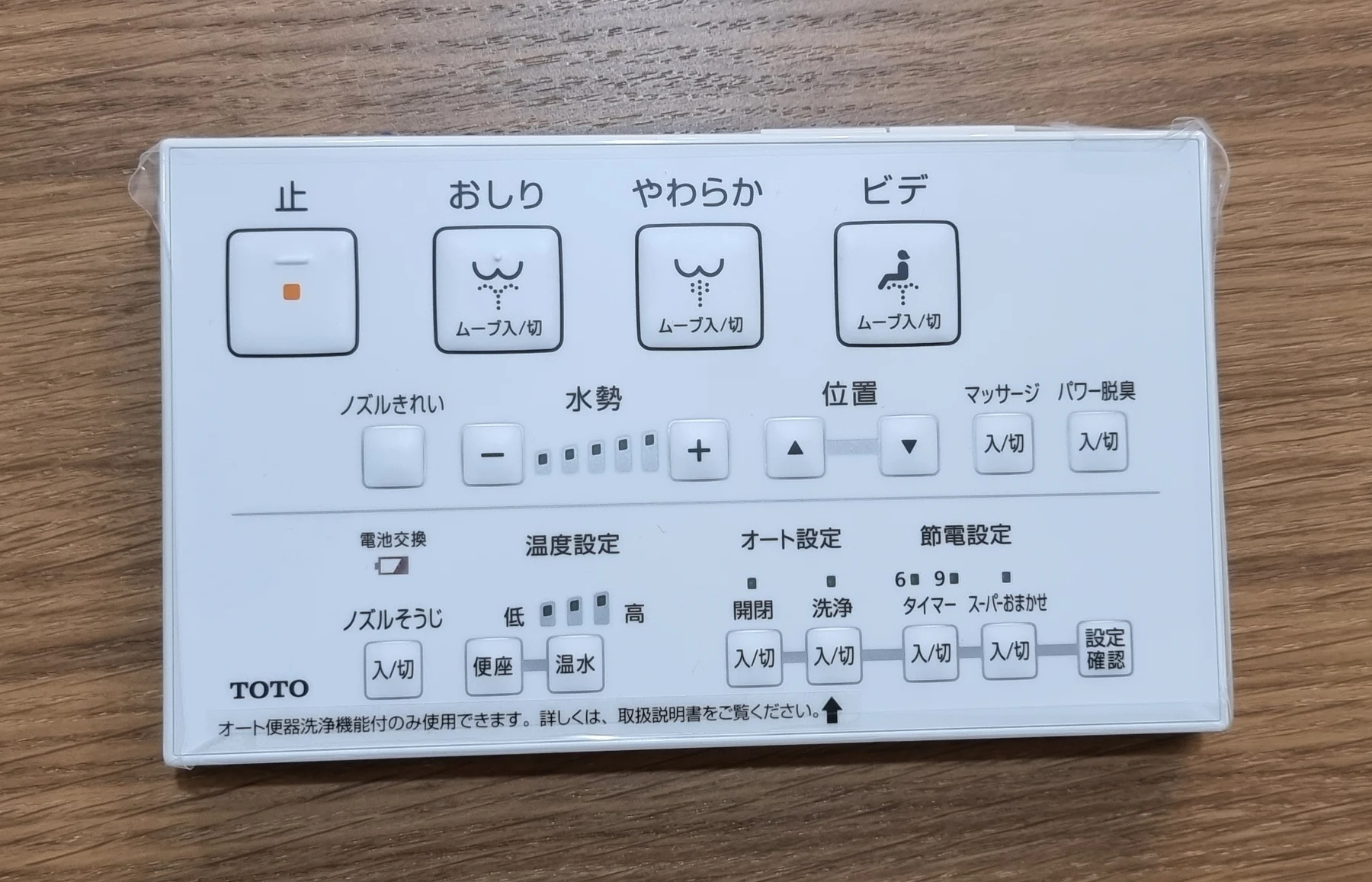
A TOTO TCF8WW88 remote on a wooden surface, with buttons for washing, spray pressure, nozzle position, seat temperature and energy saving.
Inside the control panelTOTO TCF8WW88 · Photo: Benlisquare / Wikimedia Commons · CC BY-SA 4.0 · Cropped. Tap to enlarge.

Using one

The TOTO remote in the photo puts the main choices along the top: stop, rear wash, a gentler rear wash and front wash. Below are water pressure and nozzle position, which move the spray instead of making you move. Smaller buttons set the seat and water temperature separately, clean the nozzle, deodorize and save power. Stop is the button to find first.

Owning one is not the same as using it. In an industry survey of 4,700 people with washing seats at home, 79% said they use them at least some of the time; those who do not mostly said they had never got used to it or did not know what the functions do. In January 2026 the Japan Restroom Industry Association responded with a rap video starring actor Yōichi Nukumizu, whose surname means “warm water” and who was born in 1964, the year the washing seat reached Japan.

Visitors can find the technology in public, too. Between 2020 and 2023 Shibuya opened 17 public toilets designed by 16 architects and designers, including Tadao Ando, Shigeru Ban and Kengo Kuma, all accessible and fitted with washing seats. Wim Wenders’ 2023 film Perfect Days follows a man who cleans them; Kōji Yakusho won Best Actor at Cannes for the role.

Sources &
method.

Checked September 8, 2026

Download the source data ↓

Product dates and features come from manufacturer histories and launch announcements; they describe named models, not every toilet sold in Japan. The American Bidet account uses a 2007 interview and contemporary reporting. The ownership chart reproduces the Cabinet Office’s March series for households with two or more people. The usage figure comes from the Japan Restroom Industry Association’s 2026 survey of 4,700 people who already have washing seats at home (100 per prefecture). The US surveys retain their dates and distinct samples. No current, directly comparable US ownership rate has been estimated.

  1. Consumer Confidence Survey, March 2026 ↗

    Warm-water washing toilet seats; households with two or more people; national household survey. Ownership, not use.

  2. National washing-toilet usage survey 2026 ↗

    Fielded 2025-09-29 to 2025-10-06. 4,700 respondents, 100 per prefecture, all already have washing toilets at home; age/sex quotas. Not adoption.

  3. Bathroom Experiences survey tables ↗

    September 14-19 2022, 1,000 US adult citizens; question 17 PDF page 66. Do not call it a 2026 estimate.

  4. 2025 US Bathroom Trends Study ↗

    July 6-30 2025, 1,738 registered Houzz users; unweighted. Feature percentages concern toilet-upgrading renovators, not all US households.

  5. WASHLET development history ↗

    Development involved imported Wash Air Seats; avoid claiming Japan invented every component.

  6. THE TOKYO TOILET ↗

    17 public toilets in Shibuya by 16 designers, opened August 2020 to March 2023; run by Shibuya City with the Nippon Foundation.

  7. Nippon.com: Wim Wenders and Yakusho Kōji take film to the toilet with “Perfect Days” ↗

    The film set around THE TOKYO TOILET.

  8. INAX: product heritage ↗

    Sanitarina 61 (1967), F1 (1976), SATIS (2001) and Aqua Ceramic (2016). Manufacturer history.

  9. TOTO: WASHLET product history ↗

    Dated introductions of washing, ceramic, energy-saving and automatic cleaning features. Manufacturer history.

  10. Panasonic: Arauno development and history ↗

    December 2006 launch; resin bowl and detergent-foam cleaning. Manufacturer account published in 2022.

  11. Behind the Bidet: Arnold Cohen interviewed in 2007 ↗

    Calvin Godfrey’s reporting on American Bidet and Kohler’s C3. Cohen’s lifetime-sales estimate is his own recollection.

  12. Kohler: Numi launch, April 14, 2011 ↗

    Features announced for the original Numi.

  13. Kohler: Numi 2.0 ↗

    Later product development, including voice control; not a measure of sales or household adoption.